Investing in a compact excavator is a significant step for any business owner, landscaper, or property owner. These small excavators are highly versatile, allowing a single operator to accomplish in a few hours what would take a crew days to complete by hand. They dig trenches, clear land, lift materials, and navigate spaces where a full-sized excavator could never fit.
However, because manufacturers offer dozens of configurations, weight classes, and hydraulic options, picking the wrong unit is a costly mistake. If you buy a machine that is too light, you will strain the engine trying to lift basic materials. If you buy one that is too large, you might find yourself unable to transport it legally with your current truck or squeeze it through a standard gate.
This mini excavator buying guide strips away the marketing fluff and focuses on the practical, real-world factors you need to evaluate before signing a bill of sale.
Assessing Your Primary Jobsite Needs
The first step in choosing a digging machine is analyzing the work it will actually perform most of the time. It is easy to get caught up in maximum specifications, but buying a machine based on a single extreme project is rarely profitable.
If your primary focus is residential landscaping equipment work—such as installing irrigation lines, planting trees, or building small retaining walls—your main constraints are jobsite access and surface damage. You need a narrow footprint and lightweight rubber tracks that will not fracture residential concrete sidewalks or leave deep ruts in established sod.
For contractors handling utility trenching or foundation work, digging depth and bucket breakout force take priority. You must know the local frost lines and standard utility depths in your region. Operating an excavator near its maximum physical depth limit strains the hydraulic cylinders and slows down your cycle times significantly, so you always want a comfortable performance buffer.
Farms and large rural properties present different challenges. Here, you often face rough ground conditions, dense brush, and scattered stones. You might need to compromise on a slightly larger, heavier unit that can lift round bales, clear thick roots, and handle attachments like heavy augers or brush cutters without tipping.
Navigating Weight Classes and Machine Dimensions
Mini excavators are categorized by their operating weight, and this footprint dictates everything from digging capability to transport law requirements.
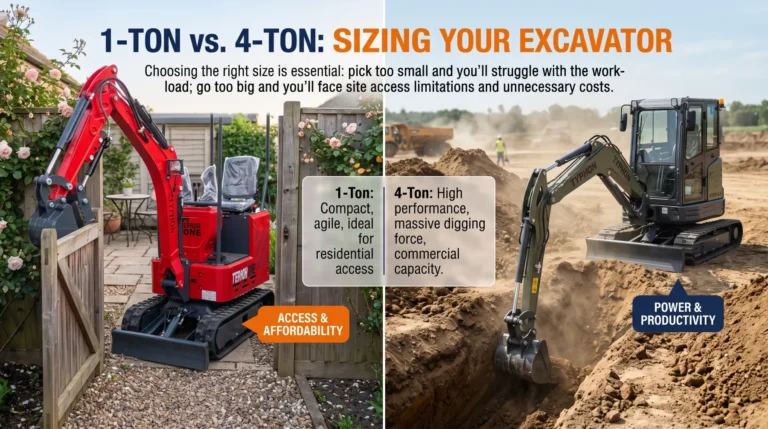
Units under 2 metric tons are highly nimble. Many of these sub-compact machines feature variable-width undercarriages. The tracks can retract to under 36 inches to slip past a residential fence gate or side walk, then expand out once the machine is in position to provide a wider, safer working base. While incredibly useful for tight access, their lifting capacity is strictly limited.
The 3-to-4-ton class is widely considered the general standard for mixed commercial and residential work. These machines offer a balanced combination of a manageable footprint and strong digging depth, typically reaching around 10 to 11 feet. They can handle most trenching, pool excavations, and demolition work without requiring specialized heavy-haul transport vehicles.
Once you cross into the 5-to-8-ton range, you are looking at large production units. These machines move substantial amounts of dirt quickly and handle large concrete trench boxes or heavy attachments with ease. However, they lose the ability to navigate tight residential properties without causing massive ground disturbance, and their physical width requires careful route planning.
Tail Swing Configurations: Balancing Stability and Tight Access
As you look through machine layouts, you will need to choose between conventional tail swing, minimal tail swing, and zero tail swing designs. This choice directly affects where you can safely operate the machine.
Conventional models feature a counterweight that extends several inches past the width of the tracks when the upper house rotates. Because that heavy counterweight sits further out from the center pin, conventional excavators inherently offer superior lifting stability, particularly when lifting heavy loads over the side of the tracks. They also tend to have roomier operator cabs and easier access to engine service panels. If you work in open spaces like fields, pastures, or large commercial lots, conventional models offer excellent value.
Zero tail swing machines are engineered so that the rear counterweight remains entirely within the width of the tracks during a full 360-degree rotation. This allows an operator to work right up against a brick wall, next to a highway barrier, or between tight rows of trees without worrying about swinging the back of the machine into an obstacle. It reduces jobsite stress and prevents body damage. The trade-off is that these units often have slightly wider tracks to maintain side stability, and the engine compartments are densely packed, making routine oil and filter changes more tedious.
Evaluating the Hydraulic System and Auxiliary Flow
The hydraulic system determines not just how fast the machine digs, but what tools it can power. Modern compact excavators function as mobile tool carriers, but they require the right hydraulic flow to do so effectively.
Standard auxiliary hydraulics run a basic mechanical or hydraulic thumb, which is essential for grabbing rocks, logs, or concrete debris. However, if you plan to run continuous-rotation attachments—such as an auger for fence posts, a hydraulic breaker for concrete demolition, or a flail mower for property maintenance—you must check the gallons per minute (GPM) flow rate and system pressure (PSI).
Running a high-demand attachment on a machine with insufficient hydraulic flow causes the attachment to stall, overheats the hydraulic oil, and robs power from the track drive motors. If attachment work is a cornerstone of your business, look for machines that offer secondary auxiliary lines and digital in-cab flow settings, allowing you to tune the hydraulic output to match the specific tool you have hooked up.
What to Inspect If You Choose to Buy Used
Because new equipment depreciates quickly, many buyers look to the secondhand market. Buying a used machine is an excellent way to save money, provided you can separate a well-maintained unit from a worn-out rental.
Start by examining the major wear points. Grab the bucket and boom arm and check for excessive play or movement in the pins and bushings. While a small amount of slack is expected on an older machine, loose joints mean the housings can become oval-shaped over time, requiring expensive line-boring repairs to fix.
Next, look closely at the undercarriage. On rubber-tracked models, inspect for deep cracks, missing chunks, and dry rot. Look at the drive sprockets at the rear of the track frame; the teeth should be flat or slightly rounded at the tips. If the sprocket teeth look sharp like shark fins, they are heavily worn and will quickly destroy a new set of tracks.
Finally, check the fluids and run the machine until it reaches full operating temperature. Look for active hydraulic leaks around the main pump, control blocks, and track motors. Check the engine oil; milky or cloudy oil indicates a blown head gasket allowing coolant to contaminate the lubrication system. Always request service records when available, as consistent 250-hour oil changes are a much better indicator of machine health than the number on the hour meter.
Understanding Transport Logistics and Total Cost of Ownership
A complete mini excavator buying guide must look beyond the initial purchase price to consider how the machine impacts your daily logistics. You must be able to move the machine legally and safely.
A small 1.5-ton to 2.5-ton excavator can generally be towed on a tandem-axle utility trailer behind a standard three-quarter-ton pickup truck. The total weight remains well within standard civilian vehicle limits, making it easy for any crew member to haul.
Once you step up to a 5-ton machine, the math changes. The weight of the excavator, combined with a heavy-duty equipment trailer, buckets, fuel, and attachments, can easily push your total towed weight past 14,000 pounds. Depending on your state or regional laws, crossing this weight threshold often requires a one-ton dually truck and may require the driver to hold a Commercial Driver’s License (CDL). Factor the potential cost of truck upgrades, specialized trailers, and driver licensing into your overall budget before making your final size selection.
Remember to consider maintenance access as part of your ownership cost. A machine that places the fuel filters, air filters, and grease points in easy, accessible locations will get serviced regularly. A machine that requires removing three tight panels just to check the hydraulic fluid level is more likely to suffer from operator neglect, leading to premature component failure down the road.
Choosing the right compact excavator comes down to a balance between your physical workspace constraints, your towing setup, and the actual depth and weight of your daily material moving tasks. Take your time, test multiple configurations under load, and prioritize a machine with a verified service history over a cheap price tag.