
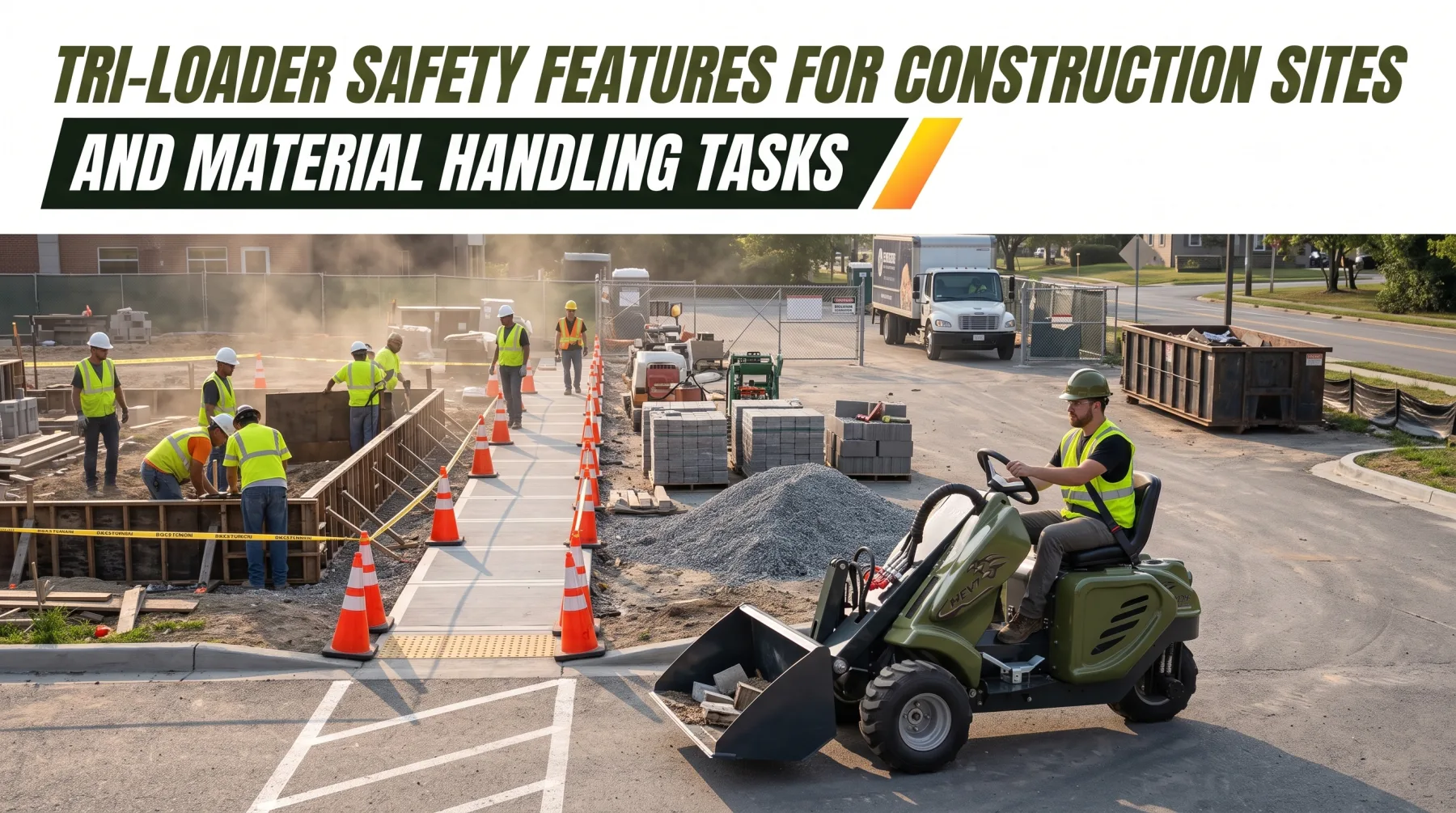
Tri-Loader Safety Features for Construction Sites and Material Handling Tasks
Tri-loaders often operate in busy construction areas where people, attachments, materials, and other equipment share limited space. Operators may switch attachments, reverse with loads, or work under conditions that can change quickly, making safety features important for controlling everyday risks. Seat belts, attachment locks, warning devices, visibility aids, and machine monitoring systems all support safer operation when used correctly.
Attachment security is especially important when moving pallets, debris, or other loads. Operators should engage the attachment locking system fully and verify that each lock is properly seated before lifting, while backup alarms, mirrors, and other visibility aids help maintain awareness around people and equipment. Machine warnings also require immediate attention, with overheating or hydraulic temperature alerts investigated before work continues.
Safe operation depends on both the machine’s built-in protection and the operator’s decisions. Pre-shift inspections should confirm that controls, safety devices, attachment locks, warning systems, and protective equipment are functioning properly, while operators should keep loads stable and respond promptly to changing conditions. Using these features as part of a consistent safety routine helps protect the crew, equipment, and productivity throughout the workday.
Operator Protection Systems
The operator station is the operator’s first line of defense on a tri-loader. Construction and material-handling work can expose the operator to tip-overs, falling material, flying debris, and contact with moving loader arms. A protected operator station creates a secure working area so the operator can load, lift, and carry material with confidence.
Depending on the model, the operator station may include a rollover protective structure, overhead protection against falling objects, side guards, and screens that keep hands and arms away from pinch points. Check the certification label on your machine to confirm what protection standard the structure meets. These components are designed to work together, keeping the operator inside a protected zone even when something unexpected happens on the jobsite.
The seat belt is the feature that makes the rest of the operator protection work. In a tip-over or sudden stop, the protective structure can only help if the operator stays inside it. Fasten the seat belt every time you operate, including short moves across the site. Where the machine has a restraint bar or operator presence system, use it exactly as the manufacturer directs, and never bypass or disable it for convenience.
Control layout matters as well. Properly positioned controls let the operator manage travel, loader arms, and attachments without leaning outside the protected area. Entry and exit also carry risk. Lower the attachment fully to the ground, shut off the engine, and engage the parking brake before leaving the seat. Use the designated steps and handholds, keep three points of contact, and never climb over or under raised loader arms.
Inspect the protective structure regularly for cracks, bends, missing bolts, and damage from contact with walls, beams, or overhead objects. Unauthorized drilling, welding, or modification can weaken a certified structure, so any structural repair should be handled by a qualified technician using the manufacturer’s procedures.
Key takeaway: Protective structures, seat belts, restraints, guards, and well-positioned controls keep the operator secure during demanding tasks, so use them on every shift and keep them in good condition.
Stability and Load Control
Stability is central to safe material handling on a tri-loader. The compact three-wheel layout creates a triangular base of support, and the machine stays stable while its center of gravity remains inside that base. Every load, lift, and turn shifts that center of gravity, which is why load placement, operating surface, and lifting practice matter so much.
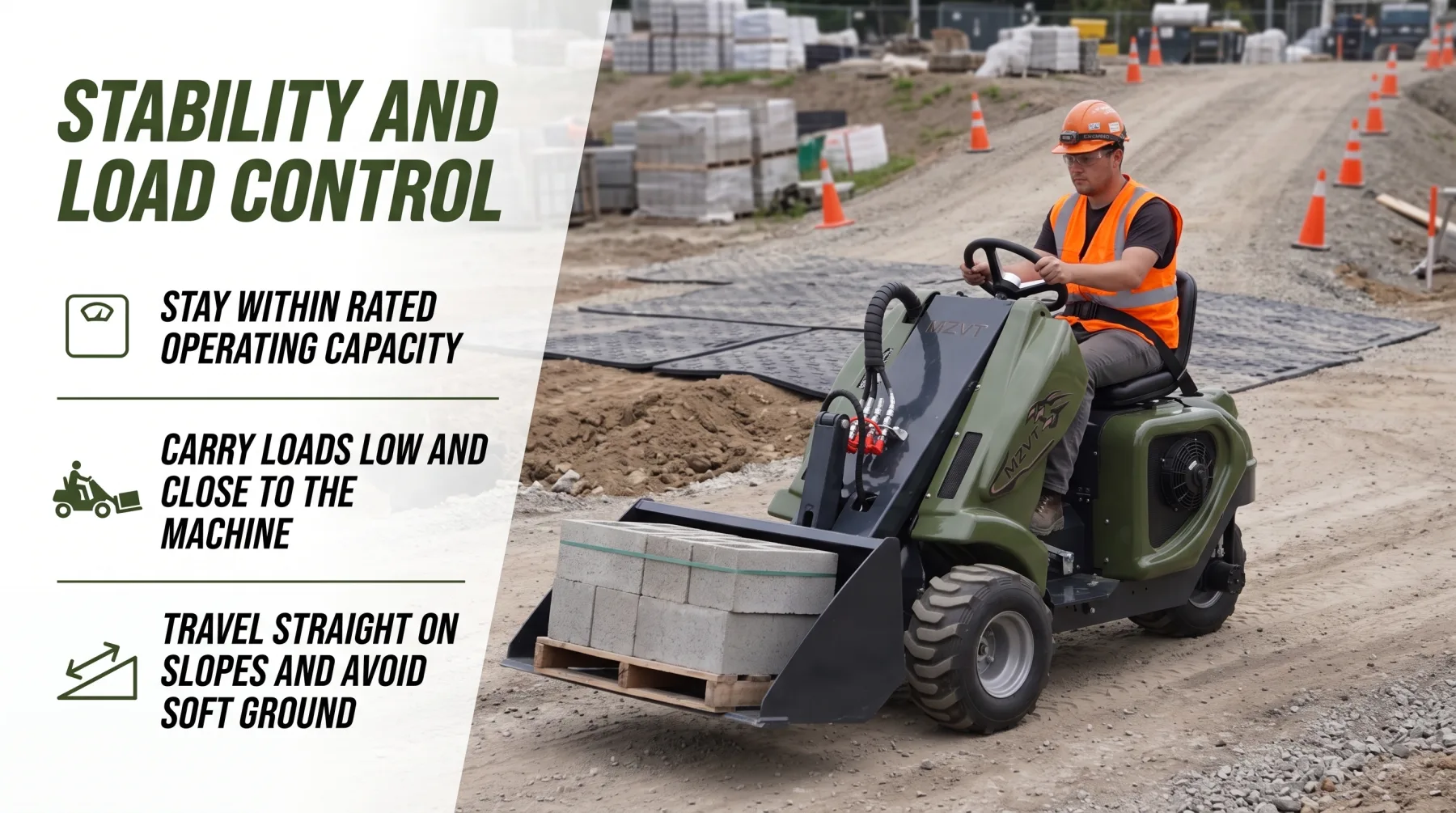
Machine design provides the foundation. Counterweighting, wheel placement, and loader geometry are engineered to balance the machine within its rated operating capacity. That capacity is listed on the machine’s decal and in the operator’s manual, and it includes the weight of the attachment. Dense materials such as wet soil, crushed stone, and stacked blocks can reach that limit quickly, so estimate every load by weight rather than by how full the bucket looks.
Load position has a direct effect on stability. A load carried high or far forward moves the center of gravity up and out, which reduces the margin before the machine becomes unstable. Pallet forks place loads farther forward than a bucket does, so the same weight can affect balance differently depending on the attachment. Center pallets on the forks, fill buckets evenly, and keep the load as close to the machine as possible.
The operating surface plays an equally important role. Soft soil, recent backfill, ruts, holes, and slopes can cause a wheel to sink or drop and tilt the machine without warning. Walk your travel routes before work begins, fill holes where you can, and lay ground protection mats across soft or sensitive areas. Follow the manufacturer’s slope limits, travel straight up and down inclines rather than across them, and avoid turning on slopes.
Good lifting practice ties it all together. Carry loads just high enough to clear the ground and obstacles, raise them only when you reach the placement point, and lower them smoothly. Avoid sharp turns with a full or raised attachment, and slow down well before rough ground. A light rear end, slow lifting, or a machine that feels unsettled are clear signals to reduce the load.
Key takeaway: Machine design, load placement, the operating surface, and careful lifting practices all influence stability, so stay within rated capacity, keep loads low and close, and assess the ground before every move.
Hydraulic Control Systems
Hydraulics power the loader arms, attachment tilt, and many of the tools a tri-loader uses on construction sites. Smooth, predictable hydraulic control allows the operator to raise, lower, and position loads precisely. That precision becomes a safety feature when the machine works close to structures, workers, vehicles, and other equipment.
Proportional controls let the operator meter movement gradually rather than jumping straight to full speed. Use gradual, overlapping inputs, especially when the load is raised or the attachment is near a wall, truck bed, or person. Feather movements to a smooth stop before changing direction, since abrupt starts and stops shift the load and send force through the machine and attachment.
Many tri-loaders include features that support safe hydraulic operation. A float function lets the attachment follow the ground during back-dragging and grading. Where equipped, hydraulic lockouts prevent loader and attachment movement while the operator enters or exits, and load-holding valves help keep the arms in position if pressure is lost. Review your operator’s manual so you know which features your machine has and how they behave.
Hydraulic behavior also tells you a great deal about the machine’s condition. Loader arms that drift down with the controls in neutral, an attachment that creeps, jerky or delayed movement, or unusual pump noise can point to low fluid, a leak, or internal wear. If you notice any of these signs, lower the load to the ground, stop work, and have the system inspected before continuing.
Inspect hydraulic hoses, fittings, and cylinders daily for cracks, abrasion, seepage, and damaged rods. Never check for leaks by running your hand along a hose. Pressurized fluid can penetrate skin and cause serious injury that requires immediate medical attention, so use a piece of cardboard instead. Relieve system pressure according to the manufacturer’s procedure before loosening any fitting or connecting hydraulic attachments.
Key takeaway: Smooth hydraulic controls allow precise raising, lowering, and positioning of loads near structures and people, so use gradual inputs, know your machine’s hydraulic safety features, and stop at the first sign of drift or uneven response.
Visibility Around the Machine
Tri-loaders often work in crowded areas where people, vehicles, materials, and structures are only a few feet away. Good visibility helps the operator monitor the attachment, the load, the work area, and everyone moving around the machine. Poor visibility is a common factor in jobsite contact incidents, especially during reversing and turning.
A well-positioned operator station gives the operator a clear view of the attachment and the ground ahead. Windows or open sightlines, mirrors, and work lights extend that view to the sides and rear and keep the work area visible during early mornings, evenings, and low-light conditions. Where equipped, cameras add another view into areas the operator can’t see directly.
Every tri-loader still has blind spots. The loader arms, the attachment, a raised load, and parts of the machine’s structure can block portions of the operator’s view. Reversing carries particular risk, since the operator may be focused on the load in front while the machine travels backward. Carry loads low so they don’t block forward sightlines, and look in the direction of travel before and during every move.
Clean all glass, mirrors, lights, and camera lenses before each shift, and adjust mirrors from the seated position. In busy or confined areas, use a trained spotter and agree on hand signals or radio communication before work begins. If anyone enters the work zone unexpectedly, stop all movement until they are clear.
Site planning supports visibility as well. Keep pedestrian routes separate from machine travel paths where possible, mark exclusion zones around loading and placement areas, and require high-visibility clothing for everyone on site. Stockpiles and stored materials should be placed where they don’t block sightlines at corners and gates.
Key takeaway: Clear visibility helps the operator monitor attachments, loads, workers, and obstacles, so keep glass, mirrors, and lights clean, carry loads low, and use spotters wherever sightlines are limited.
Attachment Security Features
A tri-loader’s versatility depends on its attachments. In a single week, the same machine may use a bucket, pallet forks, a grapple, and other tools. Each change relies on couplers, locking mechanisms, pins, and hydraulic connections to keep the attachment secure. An attachment that separates during lifting or travel can drop its load on workers, vehicles, or finished work.
Locking mechanisms are designed to hold the attachment firmly to the loader arms through lifting, carrying, and dumping. Depending on the machine, these may be manual levers that drive pins or wedges through the attachment frame or a powered lock engaged from the operator station, sometimes with an indicator showing lock status. Either way, the system only protects you when it is fully engaged.
Follow a consistent procedure for every attachment change. Position the machine on firm, level ground, and clean mud and gravel from the coupler and the attachment’s mounting points, since packed debris is a common cause of incomplete engagement. Seat the attachment, engage the lock according to the manufacturer’s instructions, and then visually confirm that every pin or wedge passes fully through its slot. Test the connection with light downward pressure before lifting any load.
Hydraulic attachments require extra care. Relieve system pressure before connecting or disconnecting hoses, wipe couplers clean to keep dirt out of the system, and route hoses away from pinch points and moving parts. Confirm the attachment is approved for the machine and that its weight, flow, and pressure requirements match the machine’s capabilities.
Inspect attachment security components regularly. Look for worn, bent, or cracked locking pins and wedges, weak springs, damaged levers, elongated pin bores, and cracks in the mounting plate. Replace damaged parts with approved components before the attachment returns to work. Never stand beneath a raised attachment, and keep others clear during connection and testing.
Key takeaway: Couplers, locking mechanisms, pins, and hydraulic connections keep attachments secure during lifting and material handling, so clean, engage, and visually confirm every connection before each lift.
Warning and Emergency Systems
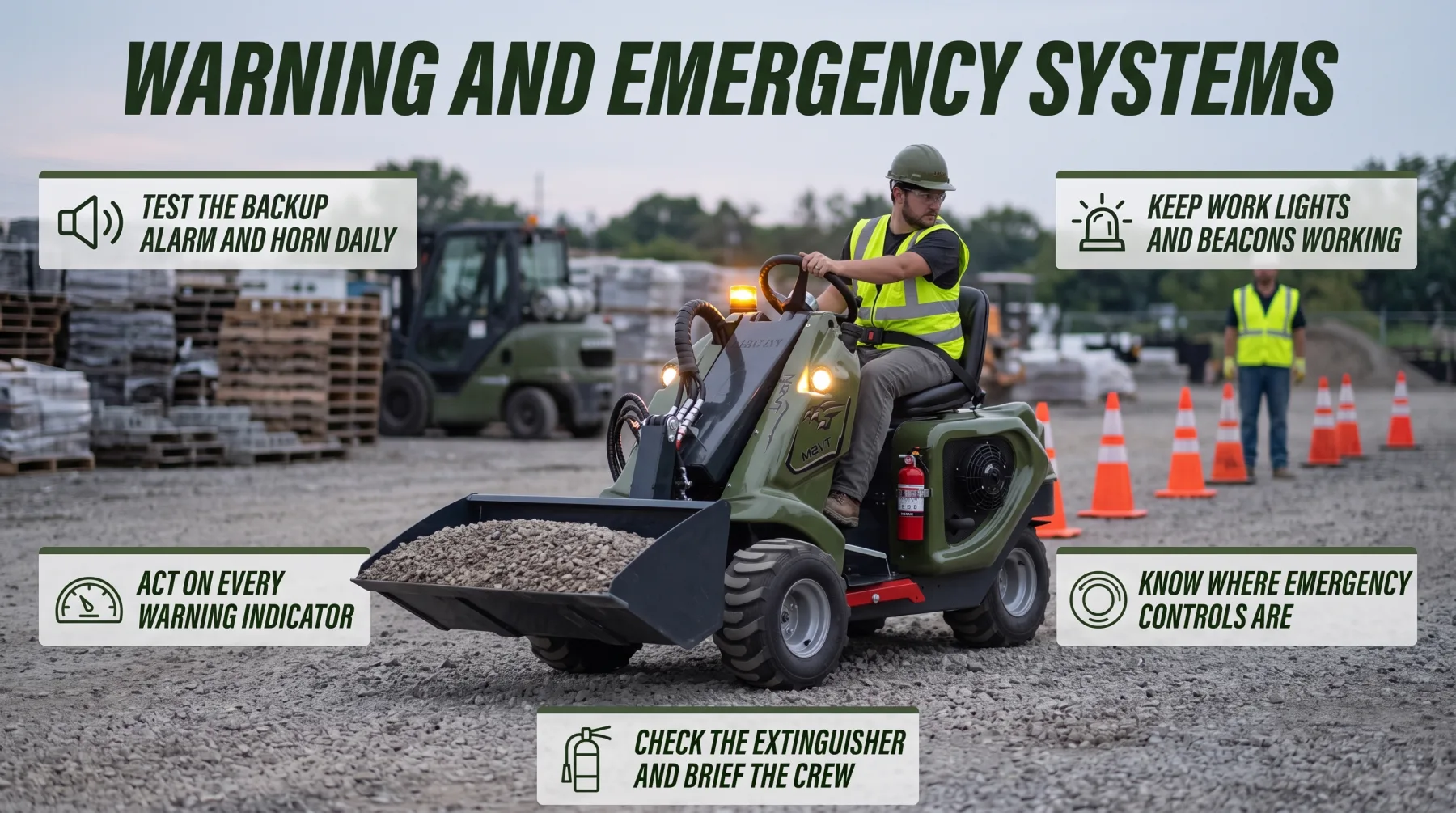
Warning systems help operators and nearby workers recognize machine movement, developing problems, and emergency conditions. Horns, alarms, lights, dashboard indicators, and emergency controls need to work properly and be checked regularly so the crew can respond quickly when something unexpected happens.
- Backup Alarm & Horn: Test both before operation and make sure they can be heard clearly in the work area.
- Work Lights & Beacons: Check that lights and warning beacons operate correctly and keep lenses clean for good visibility.
- Dashboard Warnings: Monitor temperature, oil pressure, charging, and other warning indicators, and stop safely when an active warning appears.
- Emergency Controls: Know the location and operation of emergency stop and shutdown controls before starting work.
- Fire & Crew Response: Check the fire extinguisher where equipped and ensure the crew understands alarms, signals, and emergency procedures.
Key takeaway: Alarms, lights, warning indicators, emergency controls, and fire protection help the operator respond quickly to changing conditions, so test them every shift and act on every warning.
Conclusion
Tri-loader safety features work together to support controlled and reliable operation during construction, landscaping, and material-handling tasks. Before each shift, operators should inspect the operator station structure, guards, and certification label for damage, then check the seat belt, restraint system, and operator presence controls for proper function. Stability also depends on keeping loads within the rated operating capacity, understanding the weight and density of the materials being handled, and assessing travel routes for soft ground, holes, slopes, drop-offs, and obstacles before moving the machine. Hydraulic hoses, fittings, cylinders, loader arms, and attachment controls should be inspected for leaks, abrasion, damage, or abnormal movement, while smooth control response and the absence of unintended drift help support predictable operation. Clear visibility is essential, so windows, mirrors, lights, and camera lenses should be cleaned and mirrors adjusted from the operator’s normal seating position. The coupler should be kept clean, with every attachment lock visually confirmed as fully engaged before lifting or carrying a load. Horns, backup alarms, work lights, beacons, and warning indicators should be tested during the pre-operation inspection, with dashboard warnings confirmed to illuminate during startup and operate normally afterward. Emergency controls should be identified, and the fire extinguisher should be present, accessible, and properly charged where equipped. Reviewing exclusion zones, spotter signals, pedestrian routes, and communication procedures with the crew helps keep people separated from machine and attachment movement. Regular inspection, proper maintenance, and correct use of these safety systems allow the tri-loader to provide more controlled performance while reducing avoidable risks during daily operations.
Frequently Asked Questions
What safety features are important on a tri-loader?
Important features include operator protection systems, stability support, hydraulic controls, visibility aids, attachment locks, and warning systems. These features work together to support safer lifting, travel, and material handling. Operators should understand the purpose of each safety system and follow the manufacturer’s operating procedures to help protect themselves and workers nearby.
Why is stability important during material handling?
Stable machine positioning supports controlled lifting, carrying, and placement while reducing unnecessary machine movement. Load weight and position can affect the machine’s balance, especially on uneven ground or slopes. Staying within the rated operating capacity, keeping loads low during travel, and using controlled movements help maintain stability during material handling.
How do attachment locks improve safety?
Attachment locks keep buckets, forks, grapples, and other compatible tools securely connected to the tri-loader during operation. Before each lift, the operator should visually confirm that the locking mechanism is fully engaged and that the attachment is correctly seated. Properly secured attachments reduce the risk of unexpected separation, dropped tools, or uncontrolled loads.
Why is operator visibility important?
Good visibility helps the operator monitor loads, attachments, workers, obstacles, vehicles, and other equipment around the machine. Clear sightlines are especially important when working on busy or confined jobsites. Clean windows, properly adjusted mirrors, lighting, and cameras where equipped can improve awareness and reduce the risk of contact incidents.
